
Reflections on the 2026 Statistical Leadership Symposium
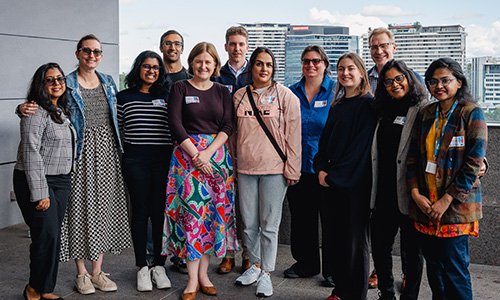
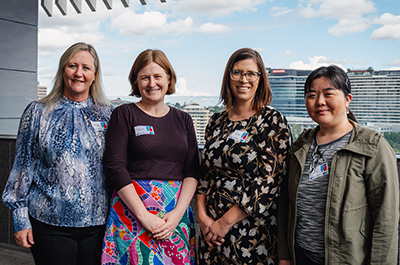
Nicole White with AusHSI higher degree research students
The inaugural Essential Skills for Statistics Leadership in Consultancy & Research Symposium 2026 was jointly hosted by the Australian centre for Health Services Innovation (AusHSI) at QUT and the Methods and Implementation Support for Clinical and Health research Hub (MISCH) at The University of Melbourne.
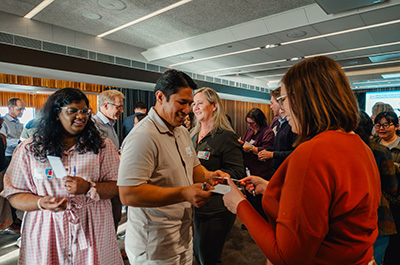
Held on 9–10 July 2026 at QUT, Brisbane and the Peter Doherty Institute for Infection and Immunity, Melbourne, the symposium brought together early- and mid-career statisticians from across Australia. The two-day event helped develop leadership skills essential for statistical consultancy, collaboration, and research, while fostering professional networks within the statistical community.
With funding support from the Theo Murphy Initiative (Australia) of the Australian Academy of Science, the 2026 symposium was designed to strengthen leadership capabilities among statisticians working in consultancy and research across academia, government, and industry.
Starting as a a shared vision between statisticians A/Prof Nicole White (Brisbane) and A/Pro Karen Lamb (Melbourne), they recognised the need to support our next generation of statisticians in developing professional leadership skills. Through their collaborative efforts, this initiative evolved into a national forum providing participants with opportunities to enhance leadership, communication, and collaborative skills essential for impactful statistical careers.
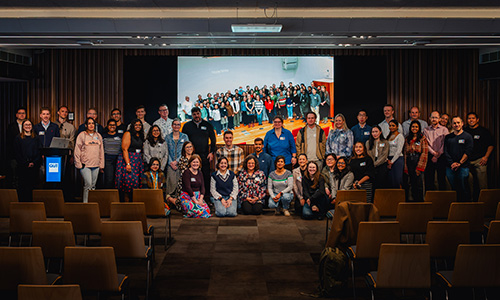 The symposium was jointly organised by AusHSI and MISCH, with the organising committee comprising Nicole White, Karen Lamb, David Price, Lizzie Korevaar, Louise Marquart, Adrian Barnett, Peixuan Li, and Anurika De Silva, whose collective efforts ensured the success of this national initiative.
Participants had the opportunity to learn from an outstanding lineup of keynote speakers across the two-day program, including Michelle Wiest, Noel Cressie, Eric Vance, Joanne Potts, Tonya Esterhuizen, Jonathan Tuke, and Emi Tanaka. Through engaging presentations and interactive discussions, speakers shared valuable insights on statistical leadership, consultancy, collaboration, communication, and career development. Participants also contributed to a priority-setting activity on professional skills they saw as most important for success as a statistician, based on their own career experiences.
Scroll down to read our symposium recap and presentation highlights from members of the AusHSI Higher Degree Research Team, who reflect on their experiences and key learnings from this inspiring event.
Day 1
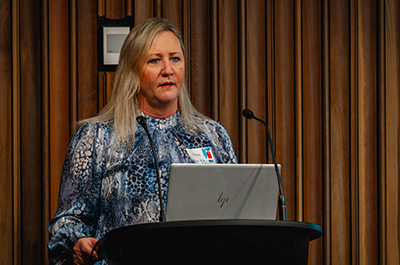
The symposium commenced with an inspiring keynote address by Michelle Wiest, who shared practical strategies for building high-performing teams, maintaining motivation, and managing cross functional collaborations. Drawing on her extensive leadership experience, she highlighted the importance of fostering trust, communication, and a shared vision to achieve successful outcomes.
This was followed by an invited presentation from Noel Cressie, who reflected on his career in statistics and data science. Eric Vance then introduced the ASCCR Framework for learning and teaching collaborative skills, which comprises five key components: Attitude, Structure, Content, Communication, and Relationship. He demonstrated how this framework can help statisticians become more effective consultants, collaborators, and communicators, enabling them to build stronger partnerships and achieve greater impact in their work.
The keynote speeches on day 1 concluded with an engaging presentation by Joanne Potts on bridging the gap between data and decision-making in statistical consultancy in the age of artificial intelligence. She emphasised that while AI offers powerful analytical capabilities, effective consultancy still relies on understanding the problem, asking the right questions, identifying what matters most to stakeholders, and integrating human judgement with statistical analysis to support informed decision making.
Day 2
Day 2 commenced with an inspiring keynote address by Tonya Esterhuizen, who reflected on her journey as the first biostatistician in Cape Town and her role in advancing the field of biostatistics in South Africa. Drawing on her extensive experience, she highlighted three core principles that have underpinned this growth: mentorship, a multidisciplinary approach, and experiential learning.
This was followed by an engaging presentation from Jonathan Tuke, who shared insights from his unique career pathway from veterinarian to statistician. He reflected on how the problem solving, communication, and diagnostic skills developed during his veterinary career continue to inform his work in statistical consultancy. Through a series of real-world examples, he demonstrated how experiences from seemingly different professions can provide valuable perspectives for consulting and collaborative work.
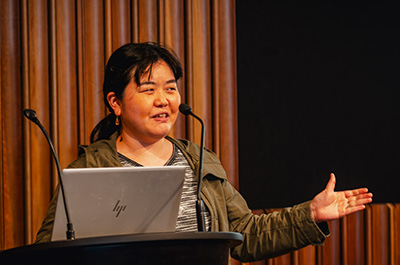
The invited presentations concluded with a thought-provoking talk by Emi Tanaka. Drawing on an example from the grain industry, she explained how the framework, practices tools that can help modern statistical leadership open dialogues including communication platforms, enable collaborative and reproducible workflows.
Key Takeaways
Through all these talks, discussions and shared experiences, one theme stood out: people and connection. It was reassuring and welcoming to see how the themes of engaging people, trusting each other, communicating, mentoring and more were interwoven through the discussions. Each talk touched on how we can help each other best work towards a common goal.